
The Guide is rarely wrong on matters of galactic significance. It may occasionally misplace a planet, underestimate the danger of Vogons, or describe Earth as “mostly harmless,” but on the subject of coastlines it displays impeccable judgement.
In Douglas Adams’ The Hitchhiker’s Guide to the Galaxy, the Norwegian fjords were designed by Slartibartfast of Magrathea, who took particular pride in their sweeping curves and won an award for the effort. It was never presented as a metaphor. It was simply stated as fact — the sort of thing one either accepts immediately or has not been paying sufficient attention.
Spend time among the fjords and the logic becomes irrefutable.
The Hitchhiker’s Guide Norwegian Fjords and the Art of Coastline Design
Slartibartfast specialised in fjords. Not continents. Not decorative deserts. Fjords. Narrow, dramatic, deeply satisfying bits of planetary engineering that curve elegantly into otherwise sensible landmasses.
The Norwegian examples remain his undisputed masterpiece: long corridors of water slicing between cliffs, improbable angles of rock and shadow, and an overall sense that someone with a very fine pencil and an alarming amount of patience has been at work.
For anyone wishing to refresh the finer details of this legendary designer, Slartibartfast, the planetary coastline designer remains one of science fiction’s most charmingly unnecessary but entirely essential characters.
Geologists insist glaciers were responsible. This explanation is tolerated politely.
Why Slartibartfast’s Fjords Look Suspiciously Perfect
The fjords possess a number of features that strongly suggest deliberate planning rather than blind geological chaos:
-
Waterways that bend just enough to maintain suspense
-
Cliffs that rise vertically with theatrical timing
-
Waterfalls placed precisely where they will be noticed
-
Light conditions that change mood faster than the Heart of Gold
Every corner produces a fresh reveal. Every anchorage feels curated. Coincidence is statistically unlikely.
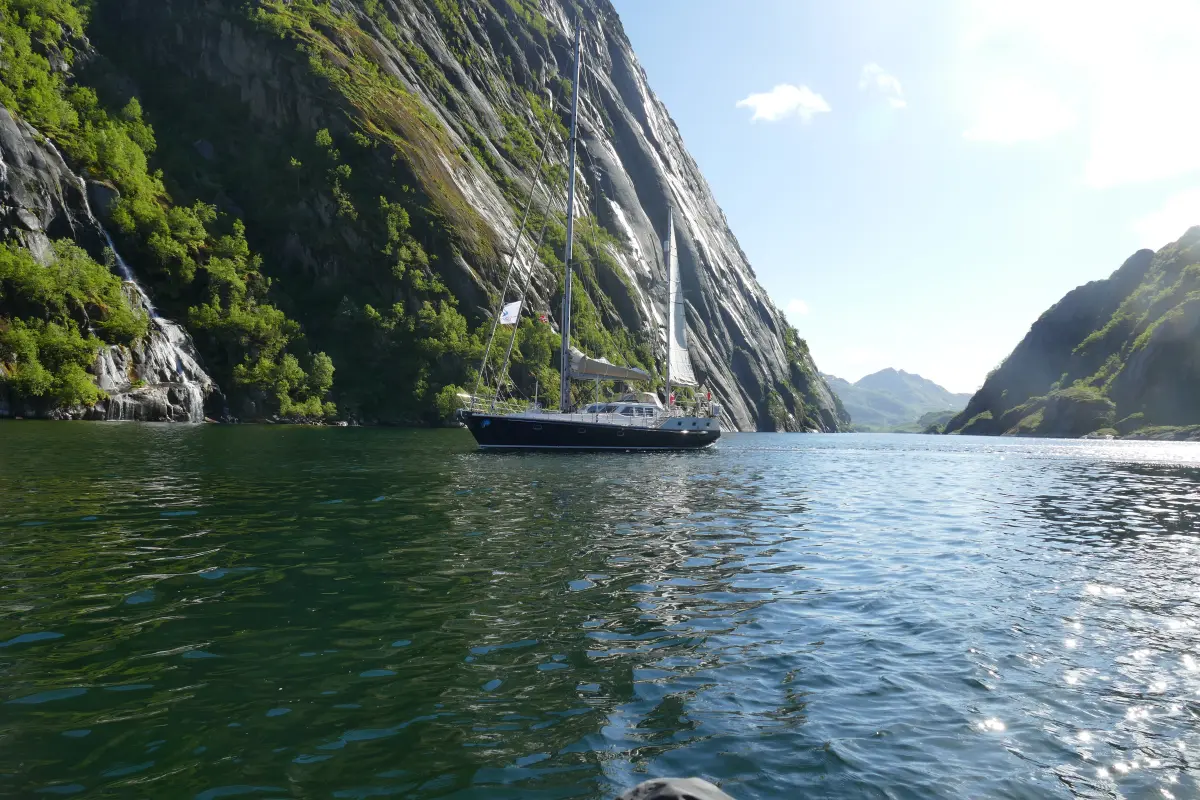
Hitchhiker’s Guide Norwegian fjords coastline with dramatic cliffs and sweeping curves
Sailing the Hitchhiker’s Guide Norwegian Fjords
The fjords behave very differently when approached by sea rather than screen. Scale becomes unavoidable. Mountains lean in. Distances stretch. Silence arrives in large quantities and refuses to leave.
Under sail or motor, progress feels purposeful but unhurried, as if the landscape prefers vessels to arrive properly rather than simply appear. Anchorages sit quietly beneath towering rock walls, villages appear in improbable locations, and wildlife occasionally interrupts proceedings for no clear reason.
This form of exploration sits at the heart of First Class Sailing’s Norway sailing adventures, where experienced skippers guide crews through these intricate waterways while blending adventure, seamanship and quietly spectacular scenery. Many of these routes pass through historic regions such as Bergen, once shaped by medieval trade networks explored in a detailed feature on how the Hanseatic League helped Bergen become a trading power.
Further inspiration can also be found in a broader overview of Norway sailing expeditions, which highlights the scale and variety of cruising grounds across the country.
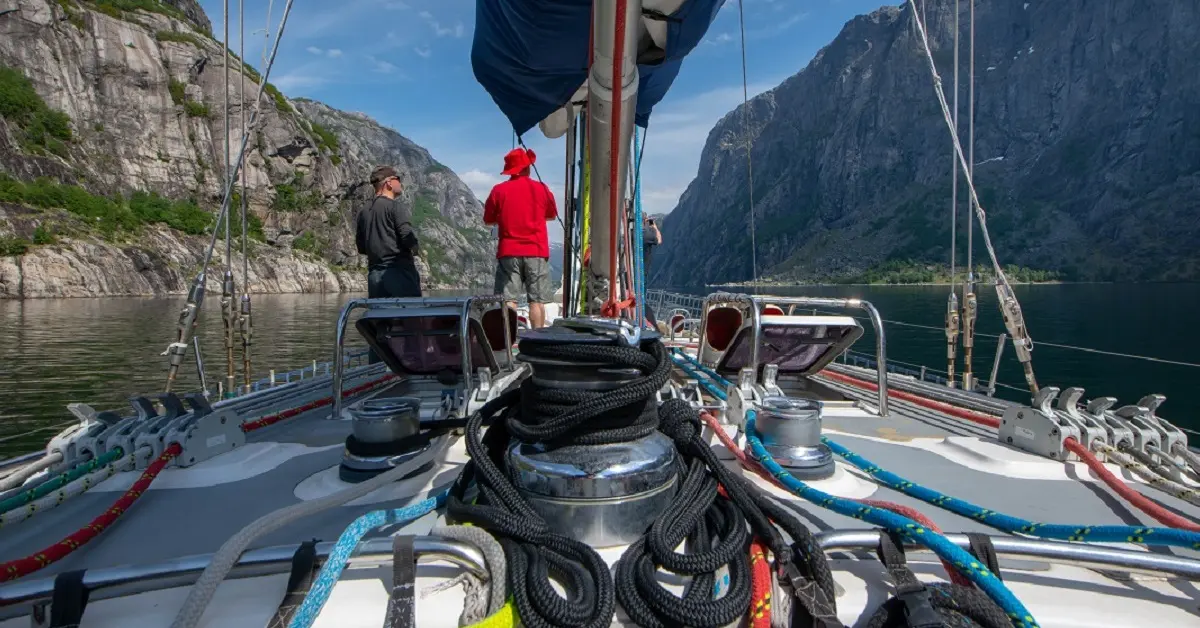
Sailing the Hitchhiker’s Guide Norwegian fjords beneath towering mountain walls
The Improbability of Scale and Silence
One of the fjords’ most impressive tricks is their ability to recalibrate perspective. Human concerns shrink rapidly when confronted by a cliff face that has been conducting serious geological business for several million years.
Wind patterns funnel unpredictably through narrow valleys. Water reflects entire mountain ranges with suspicious clarity. The horizon occasionally disappears altogether, replaced by vertical rock and cloud.
It feels less like travelling through scenery and more like navigating a particularly well-designed thought experiment.
Why Douglas Adams Chose the Norwegian Fjords
Science fiction has always borrowed generously from dramatic real-world landscapes. What sets the fjords apart is their balance between order and chaos. They are wild, but coherent. Grand, but navigable. Impressive without being hostile.
The scale and variety of these landscapes are well illustrated in the official Norway tourism guide to the fjords, while those inclined towards harder evidence can explore scientific research into the formation of fjords, which explains how glaciers carved these immense waterways over millions of years.
They look like something a slightly eccentric but deeply competent planetary designer might produce after a long lunch and a creative surge.
Slartibartfast’s pride suddenly makes complete sense.
From Magrathea to Mooring Lines
Sailing introduces a practical layer to the fantasy. Tides, weather systems, navigation decisions and seamanship quietly coexist alongside the visual drama. Fjord cruising rewards attentiveness, patience and good judgement — qualities that rarely go out of fashion, even on a galactic scale.
Those interested in exploring the fjords beyond theoretical admiration can discover upcoming routes and availability through First Class Sailing’s Norway sailing adventures, while a wider collection of trip reports and destination features can be found in the archive of Norway sailing blogs and articles.
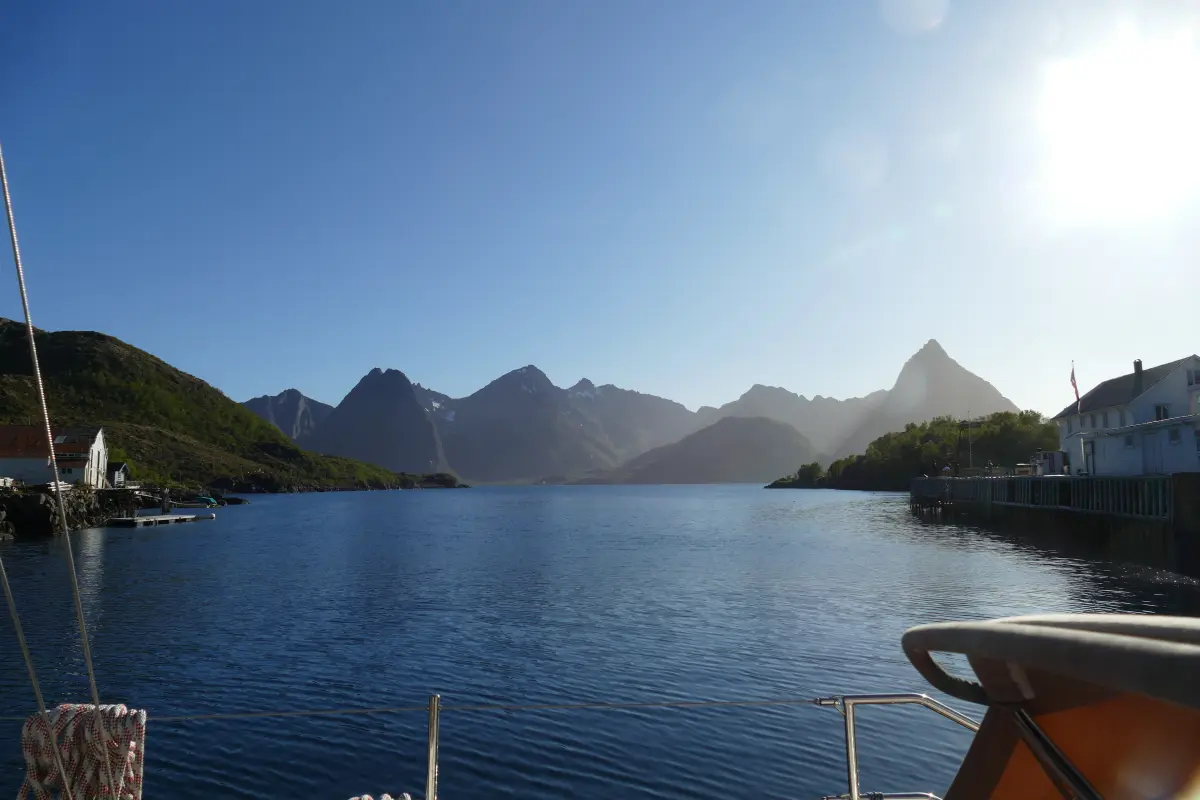
Mountains evoking Hitchhiker’s Guide Norwegian fjords alien design landscapes
A Coastline Worth Winning Awards For
Some fictional jokes age badly. This one improves with exposure.
The Norwegian fjords continue to justify their imaginary design accolade with every curve, shadow and improbable anchorage. Whether viewed as glacial engineering, cosmic craftsmanship or simply excellent scenery, they remain one of the most compelling cruising grounds on the planet.
The Guide was right. Again.
The post Hitchhiker’s Guide Norwegian Fjords: Slartibartfast Was Right appeared first on Sailing Blog.